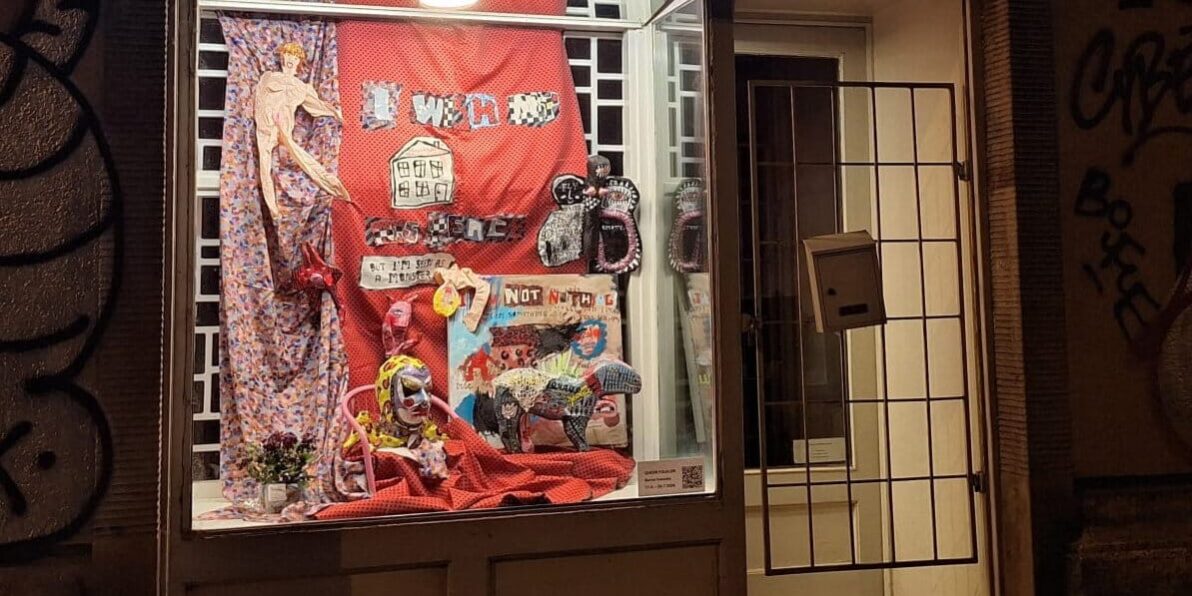
Queer Folklore proposes a shop-window scenography whose central motif is a spider—a hybrid creature marked by a vintage club-kid aesthetic, heavy makeup, and a moustache. This figure operates as a queer subject that destabilizes binary understandings of gender and identity, resisting any clear or fixed categorization. Through its hybridity, the spider becomes a symbol of an identity that exists outside socially prescribed frameworks.
The central element of the work is a space that the figure gradually appropriates and transforms into its own home. Instead of a traditional spider web, the environment is constructed through layers of fabric, collage, and found objects. The fabrics function as improvised walls and curtains, while the collages act as fragments of memory, desire, and personal narrative. Here, home is not understood as a predefined category of belonging, but as a process of making—built by hand, from accessible materials and outside normative expectations.
The text “I wish my home was peace, but I’m seen as a monster” serves as a key narrative axis of the work. It points to an experience of life shaped by social marginalization, fear, and a constant negotiation of one’s place within dominant normative systems. The spider figure becomes a projection of an identity often perceived as an anomaly, deviation, or threat, while also questioning the mechanisms through which society constructs ideas of normality and otherness.
Within the space appear small papier-mâché dolls and a sculpture of a sheep that combines both male and female characteristics. These elements function as materializations of internal states—anxiety, fear, insecurity, and emotional vulnerability. At the same time, they represent a resistance to normative ideals of beauty, bodies, and identity. However, they are not presented as threatening entities, but as participants in a shared gathering. The work thus overturns traditional notions of the monstrous and the grotesque, transforming them into a space of dialogue, acceptance, and togetherness.
The visual language of the work draws on the aesthetics of punk culture, the club kid movement, and DIY practices, while simultaneously evoking elements of folklore, ritual, and collective memory. Through the combination of contemporary subcultural references and archetypal motifs, a space emerges that exists outside of linear time. From this intersection arises the title Queer Folklore, suggesting the possibility of new mythologies and alternative narratives of identity, belonging, and community.
In the work, the spider symbolizes the builder, the creator, and the child as carriers of imagination and transformation. Through it, a personal experience is articulated—of living within identities often described as unnatural, pathological, or socially unacceptable. The work seeks to challenge such representations and affirm the right to visibility, self-determination, and dignity. The hybrid beings inhabiting the space are not depicted as anomalies to be corrected, but as subjects deserving to be seen, accepted, and recognized as beautiful.
The home the spider constructs from textiles, collages, and personal symbols ceases to be merely a shelter and becomes a space of resistance and self-affirmation. What is often perceived from the outside as chaotic, out-of-place, or monstrous is transformed from within into a site of safety, identification, and community. In the uncertain world beyond the display window, the spider creates a secure space for everything once marked as different or unacceptable, offering a vision of identity grounded in acceptance, resilience, and solidarity.