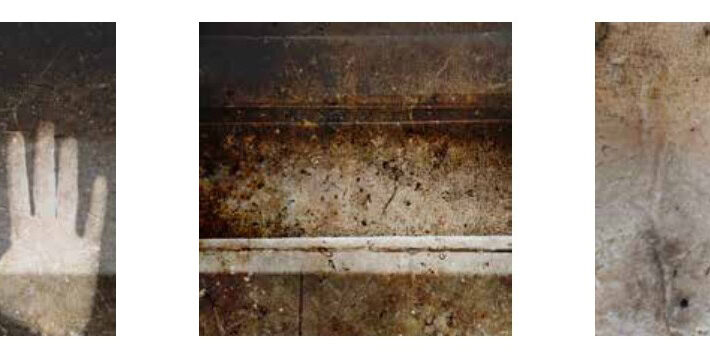
The work The Book of Genesis by Andrej Vern departs from the intimacy of everyday space in order to articulate transition as a continuous, open-ended process, freed from the notion of finality suggested by the term “post-transition.” Through the tactile mapping of the relief of stairs—sites of repetition, passage, and pause—the artist establishes a parallel between architectural fissures and personal transformations, emphasizing their temporal layering and persistence.
The materiality of the work, shaped from ephemeral and mutable substances such as flour, salt, and water, further underscores both the fragility and resilience of a body in transition. Imprints of skin and palm lines, integrated into the visual language of the work, create an intimate relationship between body and space, suggesting their interdependence and constant negotiation.
Within the context of the Domino’s trans-focused program of the Queer Zagreb season 2026, the work raises an important question of the visibility of trans artists in public space. The artist’s intention to translate the reliefs into “cracks of the street” marks a shift from the private to the collective, from personal experience to a political act of presence. Transition here is not understood solely as an individual process, but as a spatial and social intervention that calls for recognition, remembrance, and inscription into the shared memory of urban space.
The Book of Genesis thus becomes both an archive and a gesture: an archive of traces that testify to the continuity of movement, and a gesture of persistently claiming space within structures often shaped without trans experience in mind. In this sense, the work resonates with the curatorial framework of the Domina 2026 season, which does not treat trans experience as an exception, but as an active, transformative force that redefines the boundaries of body, space, and community.
The work can be viewed in the Q izlog at Petrinjska 38 from April 10 to May 18.
The Q izlog project is co-funded by the City of Zagreb.
The work of the Domino association is supported by the Kultura Nova Foundation and the National Foundation for Civil Society Development.