Workshop: Constructing Dakit
Duration: 60 minutes
Participants: 15–20 people
Participants gather to collaboratively prepare the ritual space.
Before the construction begins, the artist introduces a key idea: long before churches and temples were built, places of worship were not structures but living landscapes. Forests, mountains, and rivers were not merely settings for ritual, but were understood as sentient presences with which people maintained reciprocal relationships.
Participants collect natural materials from the surrounding environment—stones, branches, fallen leaves—and together construct a circular boundary called Dakit. Dakit marks a threshold where the visible and invisible worlds, as well as the natural and spiritual realms, acknowledge one another.
Within this boundary, a thin layer of earth is laid on the floor, transforming the ground into a living surface. Through the collective act of building Dakit, participants experience ritual as a practice that changes how attention is directed toward space. The ground is no longer neutral terrain, but a field where bodies, memory, and stories take root.
Ritual Performance: Transfiguration
Duration: 60–70 minutes
Audience capacity: 40–60 people
Participants gather inside the Dakit circle, standing on earth surrounding a cluster of softly illuminated trees whose branches glow from within.
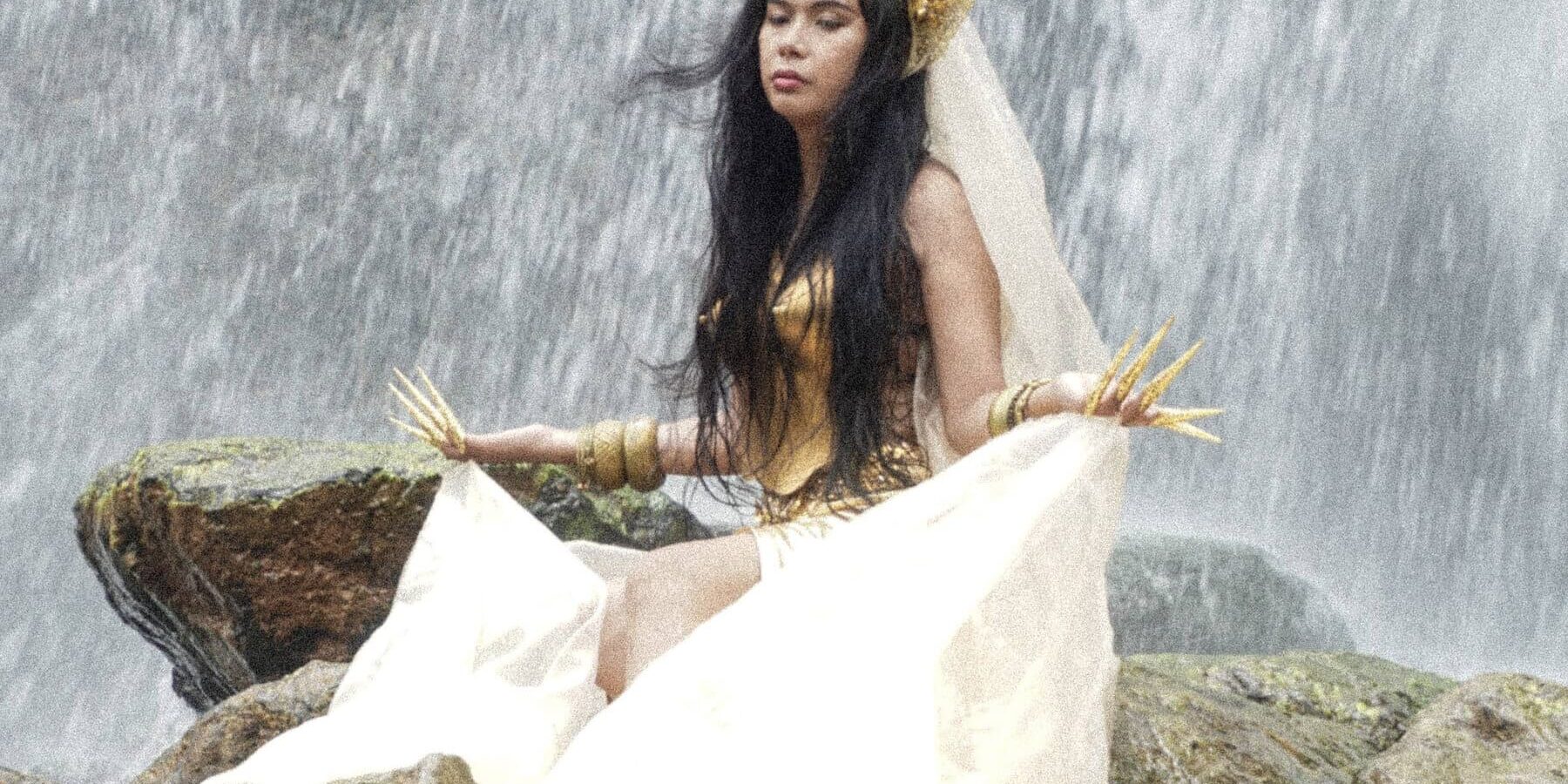
From the surrounding darkness, the sound of bells announces the arrival of the goddess. Emerging slowly, accompanied by incense carrying the scent of flowers from her homeland, the performer embodies a dark sovereign feminine presence—one that does not remain confined to temples, but comes to commune with the people.
She approaches the illuminated tree and begins to speak.
She tells of the Anamag tree, remembered by Manobo children who live at the foot of the Pataron mountain range. They say that at night its bark glows. They would gather pieces of it and sit together in its light, telling stories to one another.
In this space, the glowing tree becomes a continuation of that memory.
Around it, an ancient human impulse is invoked: the urge to gather, and the need to tell stories in order to live. Stories mattered then, as they do now, because they shape how communities understand reality. They can destroy, but they can also heal.
Through storytelling, the ritual invites a reconfiguration of narrative. Queer and trans communities are often described as resisting dominant systems. But the ritual asks a different question: what if the story has been told backwards? What if it is not us who are resisting them, but they who are resisting us—resisting our joy, our autonomy, and our ways of living otherwise?
Participants are invited to write short declarations of queer joy, queer power, queer resilience, or queer survival on fallen leaves. One by one, they read their words aloud to the circle before placing the leaves onto the branches or at the base of the tree.
As the leaves accumulate, the tree becomes a living archive—holding voices, memory, and presence. Knowledge is no longer fixed in text, but carried through voice, body, and relation.
The ritual culminates in a moment of shared recognition, as participants look at one another across the space—aware that despite centuries of attempts to erase, regulate, and dismantle our existence, we continue to gather, to speak, and to imagine.
The performance closes with a line attributed to Sappho:
“You may forget, but someone in some future time will remember us.”
The goddess then returns to the darkness from which she came, leaving behind the illuminated tree and the community gathered around it.
Ram Botero is an artist, writer, cultural worker, community facilitator and filmmaker from Mindanao, Philippines. In 2019, she directed the film Pamalugu (In Limbo), which has been screened internationally (Fukuoka Independent Film Festival, 2021), and at several national film festivals – earning accolades at the 2019 editions of the Ngilngig Asian Fantastic Film Festival and Festival de Cine Paz Zamboanga. She is currently in the production stages of her forthcoming films Eksotik (2025), Diwata (2024). Ram is one of the artists behind the photographic project ‘Diwata: Queering Pre-Colonial Philippine Mythology’, commissioned by the 2021 Southeast Asian Queer Cultural Festival, and exhibited in Fukuoka, Japan, later that same year. Ram’s essay ‘Of Myths and Goddesses: The Trans Voice in Art and Feminist Spaces’ was published in Archival Glitch, a collection of lectures by feminist artists in Asia and the Pacific. She has recently produced the performance for camera ‘Siren’s Song’ for the European Capital of Culture (Elefsina, Greece, 2023).